
Prescott Previous Residents by Era
Start with the era closest to the present and move backward. Yavapai GIS supplies the current parcel, owner, legal geography, sales, and deed references. Recorder images take the transfer trail back to 1976. Older books and indexes require office or microfilm work. Directories, the public federal census, Sanborn maps, permits, and Sharlot Hall collections then test who occupied the address and when the structure existed.
| Source | Years It Covers | Where Held | What It Shows |
|---|---|---|---|
| Recorder images | 1976 to present | Yavapai Recorder | Transfer parties, date and legal description |
| Older recorder books | Before 1976 | Recorder counter and indexes | Earlier conveyances |
| Prescott directories | Verified runs from 1903 through 1963 | Arizona Memory, FamilySearch, Sharlot Hall | Listed people, firms, addresses and occupations |
| Federal census | Public through 1950 | Genealogy databases | Households at enumeration time |
| Sanborn maps | 1890, 1895, 1901, and 1924 evidenced | Library of Congress and local sources | Footprint, use and old numbering |
| GIS permits | Mainly mid-2000s forward | Yavapai GIS | Work type and timing, not occupancy |
A modern question begins in GIS. A midcentury question begins with the 1963 criss-cross and nearby directory editions. A turn-of-the-century question combines alphabetical directories with census and Sanborn evidence. Record every gap instead of inventing a continuous run.
Start Prescott Address History Today
Search the physical address in Yavapai GIS and record the current owner, parcel number, situs, subdivision, and acquisition reference. The owner panel can show sales and recorded-document links. Mailing is the tax-bill destination and may be different from the property. That difference is crucial when tracing previous residents because ownership, billing, and occupancy are separate facts.
Parcel History identifies ancestor, sibling, and descendant parcels created by splits or combinations. Use it before assuming that a changed parcel number means a different place. Preserve the subdivision and legal description, since they can bridge older address formats more reliably than a modern street label.
Note: Assessor improvements and permit panels help date work, but neither proves who lived inside a Prescott property.
Walk Prescott Deeds Backward
The Yavapai Recorder index works like a catalog. It points toward recorded instruments but does not guarantee title, and staff will not build an open-ended chain by address, legal description, or parcel number. The researcher must connect each transfer. Spelling variants matter, and legal-description search is mainly for maps, plats, and mining claims rather than a substitute deed chain.
- Copy the current owner, parcel, situs, subdivision, and acquisition reference from GIS.
- Open Recorded Documents and Sales, then note the seller, deed type, date, reception number or book and page.
- Search that seller as an earlier grantee. Match the legal description and date, not merely the name.
- Repeat the seller-to-prior-grantee step until the online image boundary is reached.
- For pre-1976 material, use the Recorder counter, older indexes, and a specific copy request.
- Grantor and grantee
- The transferring party and the receiving party named in an instrument.
- Chain of title
- The linked sequence of recorded ownership transfers for the same land.
- Legal description
- The recorded land identity, often lot, block, subdivision, survey, or metes and bounds.
Cross Prescott's 1976 Boundary
Unofficial Recorder images are available from 1976 forward. Before that point, the exact first surviving index year and full mechanics were not established online. A copy request must provide document type, date, names, and grantor or grantee role. Pre-2014 documents use book and page, while later records use reception number. Staff need a party and a specific date for a limited search.
Ordinary copies cost $1 per page and certification adds $3. Mail requests require payment and a large enough self-addressed stamped envelope. These access rules make GIS deed references vital: they transform an address question into the names and record identifiers the Recorder can actually use.
Prescott House History Collections
Sharlot Hall Research Center joins early maps, nearly ninety years of directories, oral histories, local papers, photographs, yearbooks, phone books, and cemetery or vital reference material. An older archive account describes maps from 1864 and more than 90,000 photographs. Phone or email research includes up to 30 minutes free, may take two to three business weeks, and then costs $25 per hour.
Read Sharlot Hall's house-history account before viewing the Prescott previous residents source below.
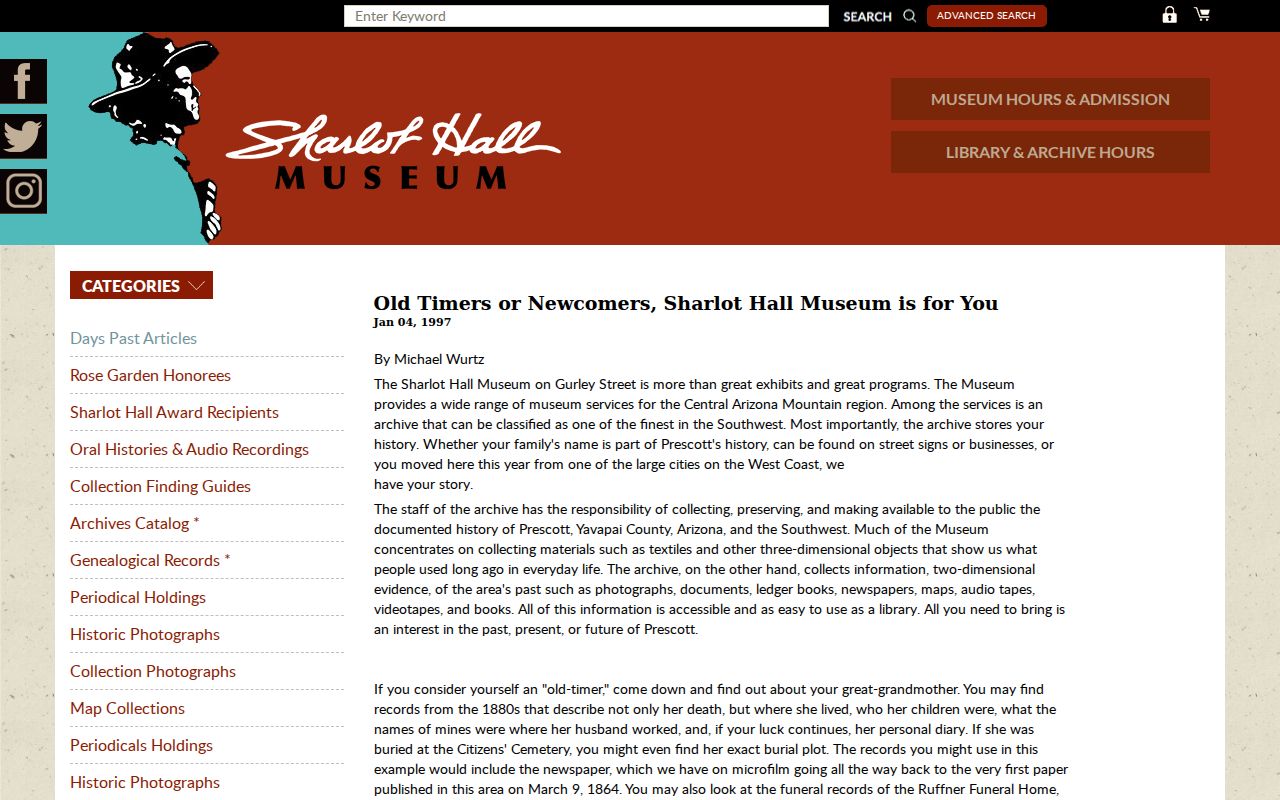
The collection supports a human-use path from lot maps and directories to streetscape images and first-person memories.
Prescott Public Library adds on-site Ancestry Library Edition, HeritageQuest, Fold3, Digital Sanborn Maps, and local digital-memory projects. Staff provide general resource help rather than complete family tracing. Deeper reference questions may receive a response within 24 hours depending on staff capacity. The library's current pages do not establish a full printed directory shelf-year inventory, so use Sharlot Hall's published midcentury holdings and Arizona Memory's digitized records for verified editions.
Pair Prescott Directories and Census
Prescott directories provide verified editions from 1903-04 through the 1963 Luskey criss-cross, with gaps. The 1963 volume reverses an address to a listed subscriber or occupant. Alphabetical editions can add a name, occupation, phone, business, or address. They do not list everyone, and a directory occupant may be a renter while the assessor owner lives elsewhere.
- Search the address in the criss-cross or locate the person in an alphabetical edition.
- Copy initials, abbreviations, street form, occupation, and edition date exactly.
- Check the editions on both sides of the hit to distinguish a move from one missed listing.
- Compare the nearest public census year, through 1950, for the household at enumeration time.
- Return to the deed chain to test ownership without merging owner and occupant.
The volume-by-volume holdings and publishers are detailed on the Prescott Directory Book page. For previous residents, the key is how a dated entry fits one address, not the history of the collection itself.
Date a Prescott Building
Sanborn fire-insurance maps show building footprint, material, height or use, doors, windows, roof, street and house numbers, boundaries, and water or fire infrastructure. Free October 1890 coverage has seven sheets, with 1895, 1901, and 1924 evidence also identified. A map can show that a structure existed by a date or explain an old block number. It cannot name the person inside.
Prescott's 1900 fire gives building context without proving a county-record loss. Research confirms destruction of the young public library collection, but does not establish that deed or court books burned. Pair the fire with Sanborn and building evidence rather than creating a false gap in the Recorder chain.
The Whipple Heights and Joslin area also shows why continuity is hard. County and subdivision records can predate the area's September 1925 annexation, so the same place may shift between local record systems.
State Archives provides a second offline fallback. Prescott city records are cataloged as record group RG 127, while Yavapai County records are RG 113. Older vital, marriage, divorce, directory, newspaper, and local-government material may route there when a city or county portal ends. The State Research Library in Phoenix is open weekdays from 8 a.m. to 5 p.m.; print or microfilm copies cost ten cents, while microfilm scans sent to email or cloud are free.
Close Prescott Resident Trails
Obituaries, probate, and historic vital images can explain where a past resident's trail ends and identify relatives or heirs. Statewide Public Access omits probate, so use the Yavapai Clerk's counter, email, phone, or mail channels. Historic Arizona birth images open after 75 years and death images after 50 years, while current certificates remain eligibility based.
Open Arizona's historic birth and death search before viewing this Prescott previous residents image.
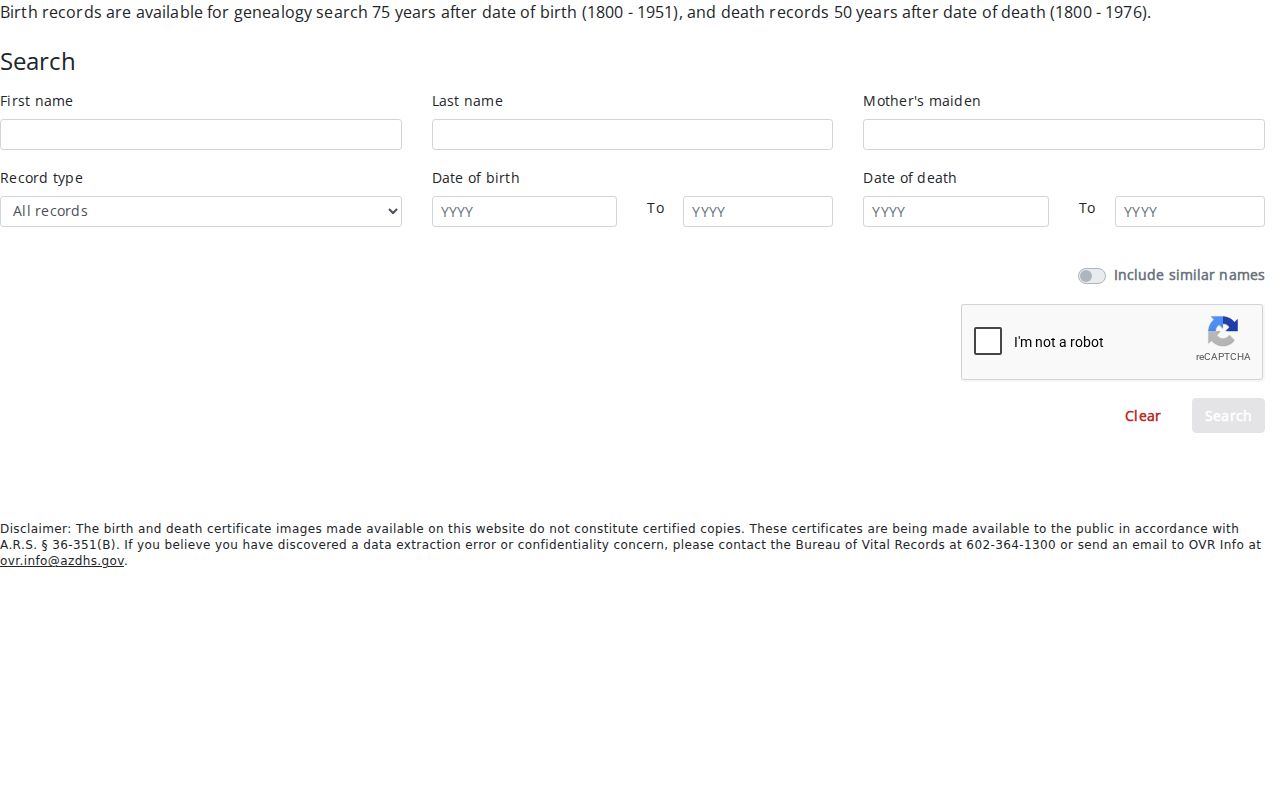
A historic certificate image confirms an event in its archival period. It does not prove continuous residence at the property being traced.
Prescott Past Residents in Context
A complete address history keeps four tracks separate: ownership from deeds, listed occupancy from directories, household evidence from the census, and building change from permits or maps. No track replaces another. The 1987 Courthouse Plaza historic survey demonstrates the local method by joining city and county files with assessor ownership and title-company deed, lease, and agreement references. Sometimes that chain supplied the only sound development-date evidence.
Write the date beside every finding. Directories and census schedules are snapshots made at different times, while deed recording and permit dates mark transactions or work rather than a household's full stay.
When the record trail breaks, return to the legal description, parcel lineage, and dated map. Do not invent a renumbering year; none was verified citywide. Use obituaries and probate only after a name has been tied to the correct address and period.
Directory scope needs the same discipline. The 1953-54 volume gives full Prescott and immediate-vicinity entries but only names for many outer communities. A name inside that county-wide book does not by itself place a person at the Prescott address. Record the section heading and scope page with the entry. The 1916 directory appendix can also separate similar initials through clubs, schools, churches, courts, societies, and public roles, but affiliation remains supporting evidence rather than proof of occupancy.
Lawful use. Prescott previous residents research supports house and family history. Never use it to track, harass, or harm a living person.