
Prescott Resident Lookup Sources
A reliable Prescott resident search starts by asking what fact needs confirmation. Yavapai GIS can connect a name with an owned parcel, but its mailing address is only the tax-bill destination and may differ from the physical, or situs, address. Recorder documents connect named parties to a legal parcel and date. Court indexes identify party roles and case events. Historic vital images establish old births and deaths, while business and professional records connect a name with a public affiliation. These sources overlap just enough to test identity without pretending that any one roll lists every Prescott resident.
| Record | What It Confirms | Where to Search | Access |
|---|---|---|---|
| Assessor and GIS | Owner, tax mail, situs, parcel | Yavapai Interactive Map | Free public search |
| Recorded deeds | Parties, instrument, parcel and date | Yavapai County Recorder | Index; images from 1976 |
| Court case | Party role, court, events and disposition | Public Access and Clerk | Basic search; official file by request |
| Historic vital image | Archival birth or death event | ADHS Genealogy | Free noncertified image |
| Business or license | Entity role, credential and status | Arizona agency portals | Public fields vary |
Choose the first index from the clue in hand. An address points to Yavapai GIS. A recorded transfer belongs with the Yavapai Recorder index. A case number goes to the Clerk, while an entity name belongs in the Arizona Corporation Commission search. A birth, death, marriage, or divorce clue requires the correct custodian because Arizona does not keep all four under one vital-record office. Preserve names exactly as displayed, including initials and suffixes, before moving to the next source.
Match the Right Prescott Resident
Same-name results are leads, not identity proof. Keep every middle name, initial, suffix, date, court, party role, and stable identification number. When property is involved, match the legal description or parcel number rather than relying on a name alone. An assessor owner can live elsewhere, and a business address may belong to an agent or office. A Prescott person search grows stronger only when independent facts agree.
Start narrow. Compare the filing date with the known period, confirm the court and case type, and distinguish the tax mailing destination from the situs address. In license records, use the license or registration number. In corporation filings, use the entity number and principal role. These checks prevent one Prescott resident from being blended with another person who shares a common name.
Identity rule. A matching name is not enough; require a second stable fact before treating a record as the same person.
Confirm Prescott Court Records
The Arizona Public Access Case Lookup is the free discovery route for basic case data from most state courts. It offers Case Search, Minute Entry Search, and Case Notification, but uses a CAPTCHA and updates weekly. Results can show the court, case number, party role, filing or event date, charges where public, disposition, and docket events. Sealed matters, protection orders, mental-health cases, many juvenile records, victim data, and probate are among the exclusions.
For selected Superior Court civil and criminal documents filed from July 1, 2010, Arizona eAccess provides paid document access after registration. The present system launched in 2024, and older accounts did not carry over. The source screen makes that account-based access clear.
Open the official eAccess portal before viewing the Prescott name-search screen below.
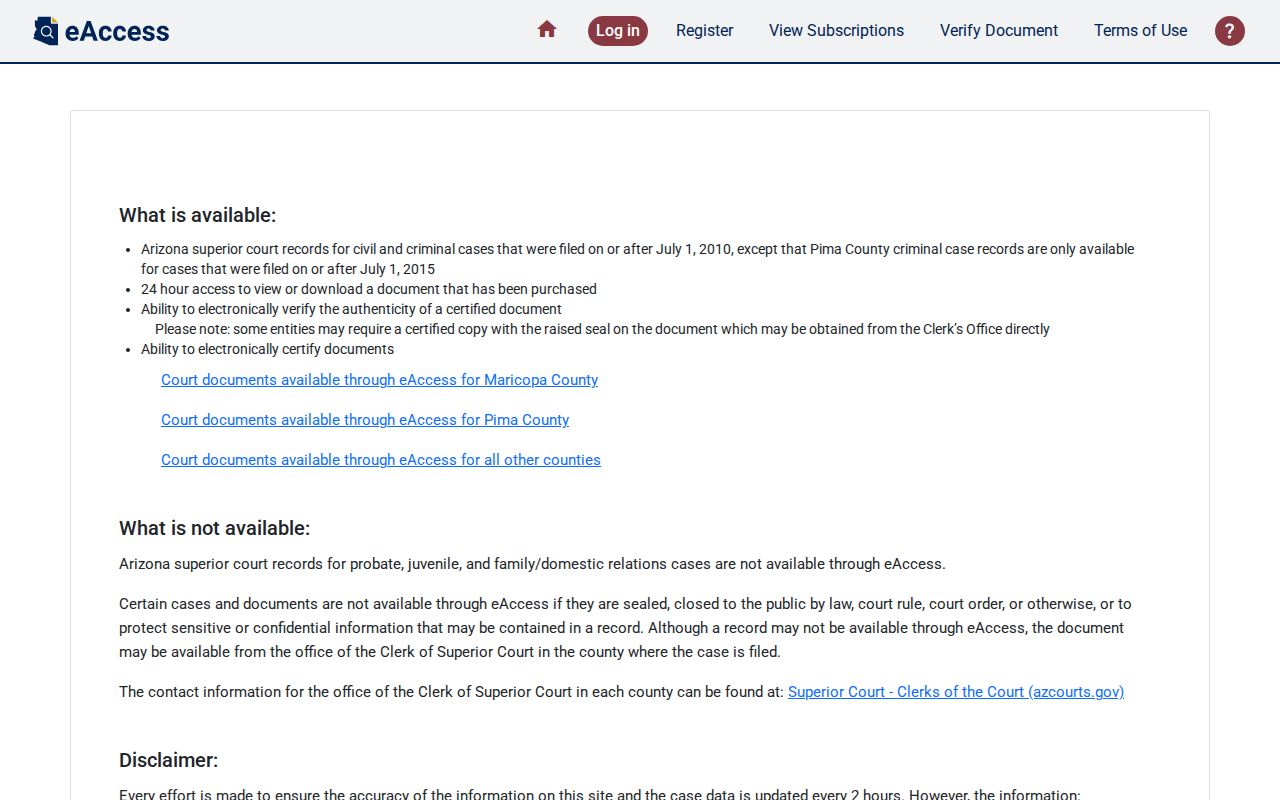
The portal is a document channel, while the Clerk remains the keeper of the official Yavapai County file.
Verify with the Yavapai Clerk
The Clerk of the Yavapai County Superior Court accepts record requests in person, by email, mail, or phone. Requests should name the party or case number and specify the documents sought. Pre-1992 material routes through the historic Courthouse at 120 S. Cortez Street, Room 207. Newer service is also available at the Justice Center. Sealed and confidential documents require proper authority and cannot be opened by a broad records request.
Ordinary copies cost $0.50 per page. A raised-seal certified copy costs $35 plus page charges, and mailed paper adds $8 unless the requester provides a self-addressed stamped envelope. Those choices matter because an online index entry is not the same as a Clerk-certified record.
Review the Clerk's official access channels alongside this Prescott court-search image.
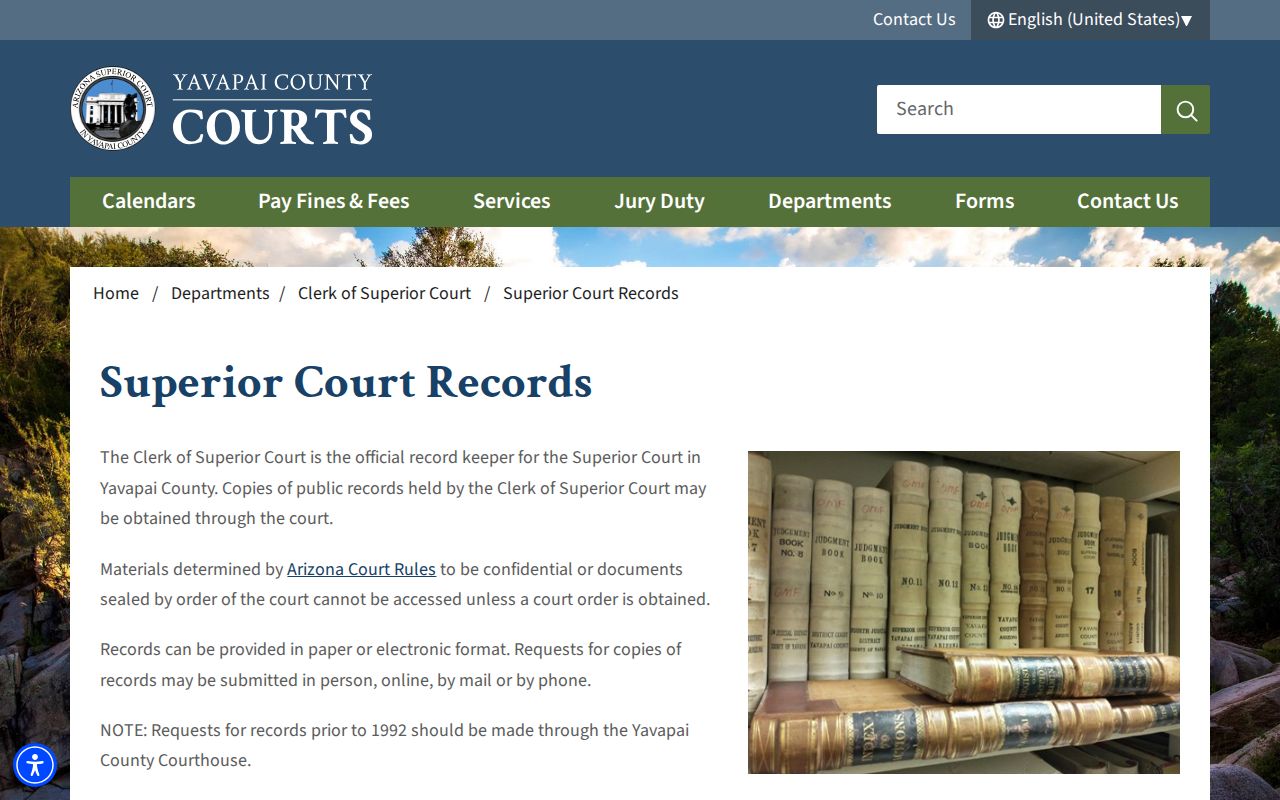
The record page is the fallback when statewide search results are incomplete, old, or absent.
Verify One Prescott Resident
Use a short chain that tests one fact at a time. Property evidence is useful when an address clue exists, but ownership must not be called occupancy. Court data can add a party role and date, while a certified copy supplies an official document when one is truly needed. A historic vital image may support an older family line, yet current certificates remain eligibility based.
- Search the Yavapai map by owner name and record the parcel, situs, tax mailing destination, and deed reference without assuming the owner lives there.
- Run exact and reasonable name variants in Public Access. Record the court, case number, party role, and event dates.
- Verify the case through the Clerk, or compare an older identity against the eligible historic birth or death image.
- Order a certified copy only from the office that holds the record. Keep the index result and the official document distinct.
- Docket
- The dated list of filings and events in a court case.
- Index vs image
- An index points to a record; an image displays the document itself.
- Certified copy
- A custodian-issued reproduction carrying official authentication, often for a fee.
Prescott Vital Record Clues
Arizona historic birth and death records open on rolling schedules. Births become archival after 75 years and deaths after 50 years under state law. The ADHS Genealogy search provides free noncertified images within its displayed date ranges. The portal's year labels may lag the annual statutory opening, so cite the displayed range when a search is made.
Current certified birth and death copies cost $20 and require identification plus proof of eligibility. Marriage licenses and divorce decrees do not come from ADHS. For Prescott events, those records belong with the filing county's Clerk of Superior Court. Adoption material is confidential under Arizona law, so family reconnection must use official court-authorized intermediary procedures rather than an open resident search.
For probate and heir research, go directly to the Yavapai Clerk. Public Access excludes probate, which makes the counter, email, phone, or mailed request the real access chain.
Prescott License Identity Checks
Professional and business indexes offer stable identifiers that help separate similar names. The Arizona Corporation Commission's eCorp system shows public entity data such as status, statutory agent, known place of business, principals, and filings. A business address proves an entity connection, not a home. Technical professionals, attorneys, contractors, medical professionals, nurses, real-estate licensees, and other occupations each have their own official regulator.
The State Bar member directory supports name, firm, city, county, language, school, jurisdiction, and status filters. Its result can establish admission and professional standing while leaving residence unresolved.
See the official State Bar lookup before viewing this Prescott resident lookup example.
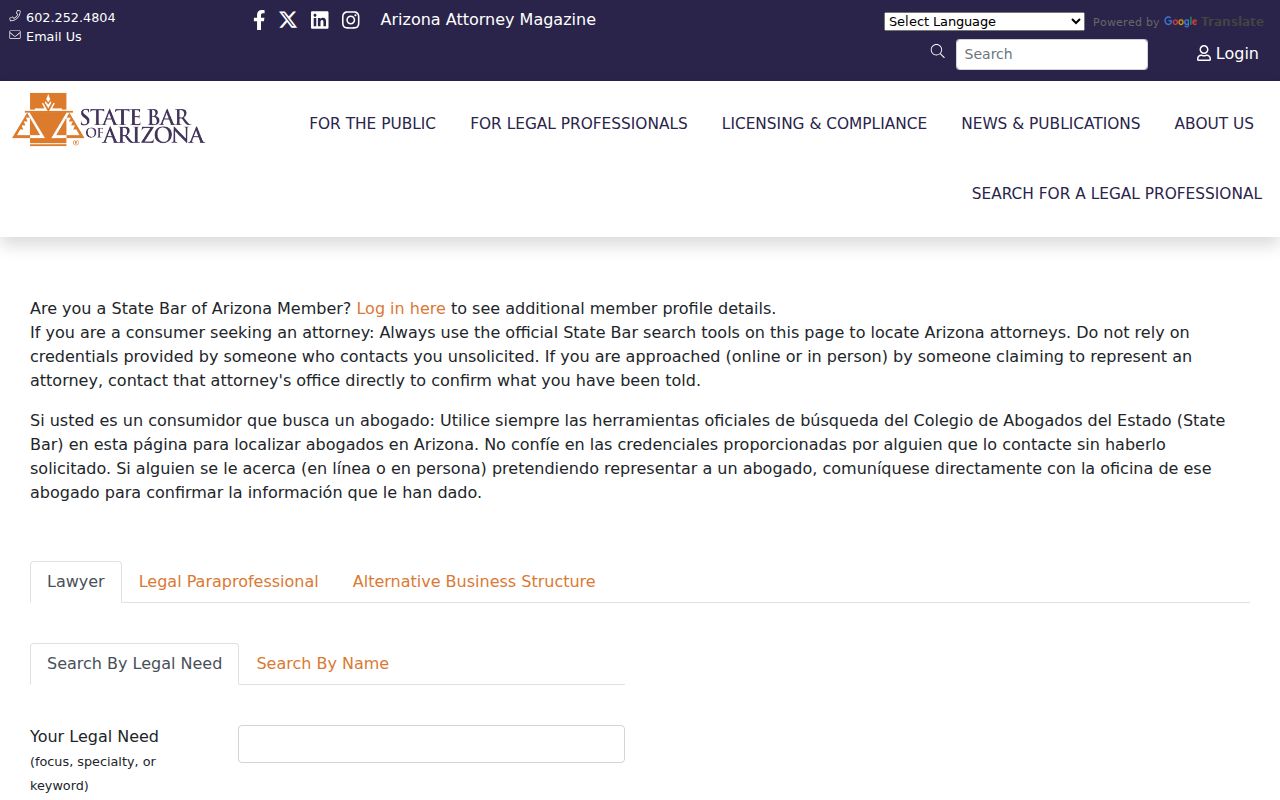
The field-rich directory works best as a confirmation layer tied to a license record, not as proof of a residential address.
| Identifier | Best use |
|---|---|
| Entity number | Distinguish corporation or LLC filings |
| License number | Confirm regulated credential and status |
| Case number | Anchor a court result to one proceeding |
| Parcel number | Anchor property evidence to legal geography |
Prescott Family Reconnection Routes
Different human questions need different official routes. An heir search begins with a probate file and then follows named parties into deeds, obituaries, or archival sources. A former classmate is more likely to appear in Arizona Memory's yearbooks, which span 1903 through 1996, or in Prescott Public Library and Sharlot Hall collections. A birth-parent search must respect sealed adoption records and use Arizona's authorized confidential-intermediary process.
The digitized Whipple Echo, made available in April 2025, adds a person-rich source for veterans, hospital staff, and the Whipple community. Names found there still need dates and affiliations matched before they are treated as the same Prescott resident. Newspaper mention is context, not current-location proof.
When a public record is not online, submit a specific request naming the person, record type, date range, and desired format. Arizona Public Records Law calls for records to be furnished promptly, but sets no universal number of response days.
Prescott Resident Lookup Limits
A Prescott resident lookup stops at protected addresses, sealed cases, restricted certificates, adoption and juvenile files, DMV data, utility accounts, and confidential voter fields. The Arizona voter portal authenticates a person's own record and is not an open name-to-address directory. Voter-file use and redistribution are restricted by A.R.S. §16-168.
Arizona's Address Confidentiality Program supplies a substitute address to qualifying survivors through registered application assistants. Separate statutes allow eligible people to seek protection for Recorder, Assessor, Treasurer, and voter addresses. A wrong public entry should be corrected by its actual custodian: Assessor for parcel facts, Recorder for deed indexing, Clerk for court entries, the board for a license, and County Recorder for registration.
Lawful use. A Prescott resident lookup is for lawful personal research. Never use a record to stalk, harass, intimidate, or harm anyone.
Commercial compilation tools can be stale and can merge different people. Official custodians are the verification point. That distinction matters most when a resident lookup affects family history, an heir search, civic research, or personal safety.