
Prescott Directory Collections by Era
Verified holdings begin with a city and business book, continue through statewide and county volumes, and reach an address-first criss-cross edition. Access is split among free scans, institutional digital systems, library microfilm, and the Sharlot Hall Research Center. A missing year in this inventory means the year was not verified in the research, not that no directory was ever issued.
| Collection | Years | Where held | Access |
|---|---|---|---|
| Prescott City and Business Directory, Journal-Miner | 1903-04 | Arizona Memory and Arizona Historical Society | Free PDF |
| Polk Arizona/New Mexico Gazetteer | 1912-13 | State Research Library and FamilySearch | Free digital, statewide business focus |
| Yavapai County Directories, Arizona Directory Company | 1913, 1916, 1919, 1922 | Arizona Memory | Free scans |
| Prescott/Jerome microfilm | 1916, 1923, 1928, 1929 | Gale library microfilm | Institutional access, reported reel gaps |
| Prescott City Directory | 1939 | FamilySearch and State Library | Online, check title page for publisher |
| Prescott/Humboldt series | Apr/Oct 1951; Aug 1952; summer 1953; 1953-54; summer 1954; May 1955; July 1956; June 1957; July 1958 | Sharlot Hall Research Center | On site or research service |
| City and Cosmopolitan Telephone Directory | 1961 | Sharlot Hall Research Center | On site or research service |
| Luskey's Prescott Criss Cross | 1963 | Arizona Memory catalog and FamilySearch | Address-first; copy restrictions apply |
The publication timeline is substantial but not continuous. The exact last printed Prescott edition was not established. Scope matters just as much as the year, since county-wide books can mix full city entries with much thinner treatment elsewhere.
Prescott Directory Timeline
The publisher and format changed as Prescott grew from a territorial center into a regional hub. The dated milestones below are firm anchors for a search. They keep a family or address trail tied to a source that actually survives.
- 1903-04: Journal-Miner Company issued a Prescott city and business directory now available as a free Arizona Memory scan.
- 1912-13: R. L. Polk published the Arizona/New Mexico Gazetteer with a statewide business emphasis.
- 1913-22: Arizona Directory Company issued verified Yavapai County volumes in 1913, 1916, 1919, and 1922.
- 1939: A Prescott City Directory survives through FamilySearch and the State Library.
- 1951-61: Sharlot Hall holds a detailed run of Prescott/Humboldt and telephone volumes.
- 1963: Luskey's Prescott Criss Cross added a verified address-first route into listed occupants.
Directory dates are publication snapshots, not proof that a person remained at an address all year. Compare the edition before and after a move whenever both exist.
Journal-Miner Prescott Directory
The 1903-04 Prescott City and Business Directory is the earliest verified city volume in the collection. Journal-Miner Company published it, linking the directory tradition to the newspaper record that also preserves names, firms, notices, and local events. Arizona Memory's directory record provides free digital access.
Search the alphabetical section first and save the title, scope, and abbreviation pages with the entry. Business entries can carry proprietors or managers, while an address may appear as a street location or post office box. Advertisements and cross-references can add a trade, partner, or alternate firm name. The directory should be read as a period index, not a census.
Note: Record initials and punctuation as printed because later Prescott volumes may spell out the same person or list the firm instead.
Inside Prescott's 1916 Directory
The 1916 volume identifies Arizona Directory Company at 126 W. Washington Street in Phoenix and carried a $6 price. It combines alphabetical listings of firms and private citizens in Prescott, Jerome, and principal towns with a classified business directory. Its appendix lists state and municipal officials, courts, societies, schools, churches, and clubs.
That appendix solves a common initials problem. When two people share a surname and first initial, an institutional tie can separate them. A school, court, society, church, or club listing may connect the short resident line to a fuller newspaper or organizational record. The link proves an affiliation in the stated edition, not residence beyond that date.
Prescott Directory Scope Trap
The 1953-54 volume is complete for Prescott and its immediate vicinity, but many outer communities receive names only. Ash Fork, Bagdad, Camp Verde, Chino, Clarkdale, Cottonwood, Jerome, Mayer, Seligman, and Yarnell appear within the same broad volume. A name in that book therefore does not by itself place someone inside Prescott city limits.
Read the scope page, place heading, and entry structure before assigning geography. County titles are catalog descriptions, not city residency claims. The same caution applies to the 1963 Luskey volume, which includes Bagdad, Chino Valley, Humboldt, and Mayer as well as Prescott. This local indexing quirk is why edition context belongs in every citation.
The Sharlot Hall directory-holdings inventory identifies the detailed midcentury run.
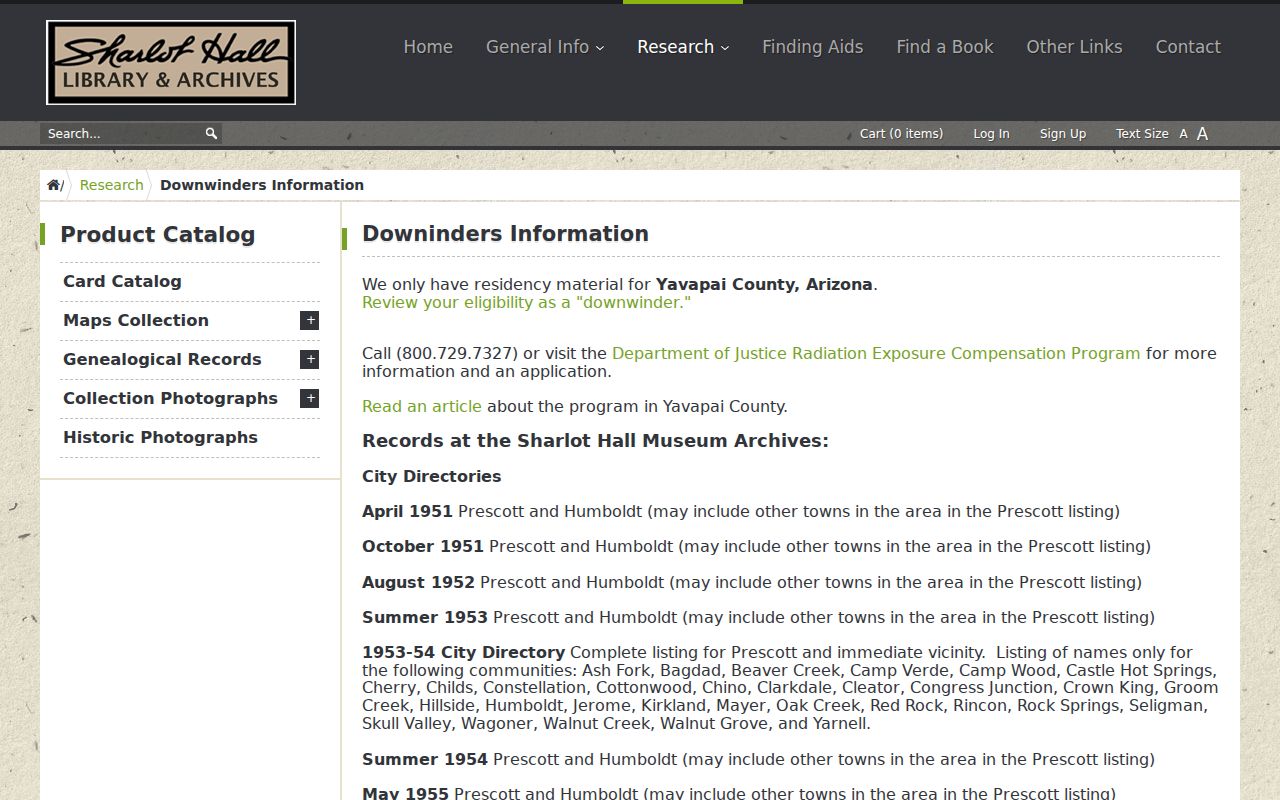
The visible holdings help distinguish a verified Prescott edition from a vague claim that every annual book survives.
Read a Prescott Directory Entry
Accessible Prescott examples expose a clear but limited field set. Do not import symbols from another city's publisher unless the local title page confirms them. In the verified examples, an entry may identify a person or entity, give initials or proprietors, state a trade or role, show a street or post office address, and supply a telephone exchange and number.
| Indexed name | Person, firm, or organization under the publisher's filing rules |
|---|---|
| Given name or initials | Identity clue that should be copied exactly |
| Proprietor or manager | May appear in parentheses with a business entry |
| Occupation or category | Trade, business class, or sometimes a role |
| Address | Street number and street, or sometimes a post office box |
| Telephone | Period exchange and number when printed |
| Cross-reference | Pointer to another name, firm, or advertisement |
A visible example for Yavapai Block Company combines the entity, proprietors, W. Sheldon address, and telephone in one line. The research did not verify spouse, widow, or owner-versus-renter marks on a private-household page, so those fields should not be assumed for Prescott.
- Criss-cross directory
- An address-first arrangement that reverses a street location to a listed subscriber or occupant.
- Householder index
- A name or address finding aid for the people designated by that publisher as principal listings.
- Abbreviation key
- The edition's own legend for shortened trades, addresses, roles, and cross-references.
- Scope page
- The front matter that states which cities, towns, districts, or classes of entries a volume includes.
Reverse Prescott's 1963 Directory
Luskey's Prescott Criss Cross is the rare verified address-first tool. Instead of beginning with a surname, start with the printed street and number. Record the listed subscriber or occupant, then check the alphabetical side or nearby editions for more context. The volume can reveal who was listed at one address and who appeared along the same road.
A criss-cross line is not an ownership roll. The listed occupant may have rented, while the assessor owner may have received mail elsewhere. It also does not enumerate every household member. For a modern address chain, use the Prescott street directory method and compare the historical line with the parcel and deed rather than merging them.
Note: Access restrictions apply to the cataloged 1963 copy, so Sharlot Hall or library staff may be the practical route when remote access fails.
Trace Prescott Families by Directory
A family trail is strongest when each directory line is treated as a dated observation. Preserve initials, spelling, employer or trade, address, phone, and cross-references. Then compare adjacent editions. One missing year can mean a move, death, unlisted phone, publisher omission, or a gap in the surviving collection.
- Begin with the most certain name, address, or business and choose an edition that covers the right community.
- Copy the full entry and the volume's title, year, page, scope statement, and abbreviation key.
- Check the prior and next verified editions. Note address, trade, firm, and phone changes without guessing at the cause.
- Pair directory snapshots with the 1910, 1920, 1930, 1940, or 1950 federal census where the dates fit.
- Use a criss-cross edition for an address-first check, then compare the parcel or deed if property ownership matters.
- Close the gap with newspapers, obituaries, probate, yearbooks, maps, photographs, or oral histories held by the local archive.
Census and directory dates represent different moments. A census household can include people omitted from a city directory, while a directory can fill the long span between federal enumerations. Neither should be forced to match the other.
Prescott Directory Access Channels
Prescott Public Library local history is the city access point for genealogy support and digital resources. The library is at 215 E. Goodwin Street and can be reached at 928-777-1500. Its genealogy tools include in-library Ancestry Library Edition, HeritageQuest, Fold3, Digital Sanborn Maps, Digital Arizona Library, and Prescott memory projects. Staff can offer resource help, though they do not perform full family tracing.
For statewide and offline fallback, the State Research Library holds digital and microfilm material, while Arizona State Archives catalogs Prescott records as RG 127 and Yavapai County records as RG 113. FamilySearch carries several identified editions but may apply account or access restrictions. Arizona Memory supplies free scans where digitization is complete. Together, these channels cover web access, institutional databases, microfilm, on-site retrieval, and staff research service.
Do not invent a missing year from a nearby run. Search the catalog, ask the holding archive for the exact title, and cite the title page once found.
Prescott Veterans in Digital Records
Arizona Memory digitized the Whipple Echo on April 25, 2025. Issues from the Veterans Hospital and Whipple Barracks add names of veterans, staff, and people in that institutional community. The paper can bridge a gap between city directory editions, especially when a person lived or worked within Whipple's orbit.
The digitized Whipple Echo collection is now available through Arizona Memory.
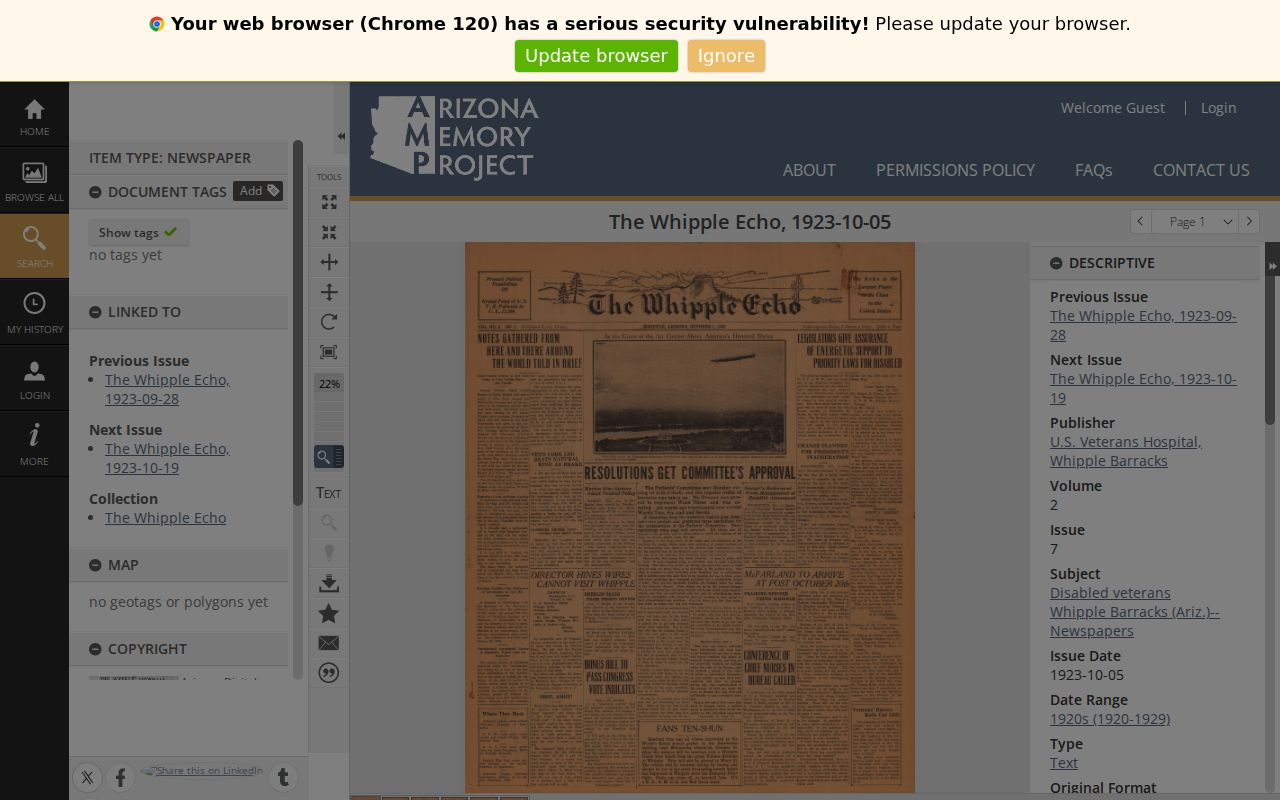
A newspaper mention should be matched by date, address, role, or institution before it is joined to a directory name. This is especially important when only initials appear.
Prescott Fire and Directory Context
The July 14, 1900 fire reshaped Prescott's downtown commercial core and encouraged brick construction standards. It destroyed the young library collection in the Bashford building, after which donations and insurance helped rebuild it. The library became city-run in 1917. That story explains why maps, building records, photographs, and early directories may need to be read together for downtown research.
No authoritative source in the Prescott research says the fire destroyed county deed or court books. It must not be turned into a false courthouse-record gap. Pair the fire with Sanborn and building evidence, not an assumption that government records vanished. The October 1890 Sanborn set contains seven sheets, and later mapped editions can track the built setting without naming occupants.