
Finding Prescott Residents by Clue
A useful Prescott resident search starts with the clue, not a broad name query. A street address points first to the Yavapai County Interactive Map. A person's name can be tested against ownership, recorded documents, a court party index, a business filing, or a professional license. An old address belongs in a deed chain, printed directory, census, newspaper, and probate trail. Each record describes one relationship at one date. None serves as a full household roll.
The safest method records middle names, initials, suffixes, dates, parcel numbers, and case or license identifiers as they appear. The Assessor owner may not live at the situs address, and a tax mailing address may lead elsewhere. A directory occupant may have rented. A same-name court result can concern another person. Those limits make cross-checking the core skill behind a Prescott resident-roll search.
- Translate a current address or owner name through the county parcel map.
- Save the APN, situs, mailing address, legal description, and deed reference.
- Check the Recorder, court, business, license, or vital index that fits the question.
- Use local directories, newspapers, census schedules, and probate for older people.
- Ask the right custodian for a specific record when the online trail ends.
Prescott Residents Records Custodians
Prescott is the Yavapai County seat, but resident records are split among city, county, and state offices. The county Assessor and GIS staff maintain parcel facts. The Recorder keeps deeds, mortgages, plats, surveys, trusts, and voter registration. The Clerk of Superior Court holds court, probate, and marriage files. Prescott City Clerk records include agendas, ordinances, resolutions, and requested city material. Arizona agencies handle current vital certificates, corporations, licenses, and statewide court discovery.
Yavapai County Recorder
1015 Fair Street, second floor
Prescott, AZ 86305
928-771-3244, option 6
Yavapai County Assessor
1015 Fair Street
Prescott, AZ 86305
928-771-3220
Interactive Map property search
Prescott City Clerk
201 N. Montezuma Street
Prescott, AZ 86301
928-777-1437
City public records and JustFOIA
Counter, mail, email, phone, and public-terminal access still matter. Recorder copies can be ordered by mail or at the counter. The court Clerk accepts requests in person, by email, mail, or phone, while pre-1992 files route through the historic Courthouse. Arizona Public Records Law requires records to be furnished promptly, but it does not set one universal number of days.
Prescott Parcel Records Switchboard
The Yavapai County Interactive Map is the strongest first stop for a current Prescott address. Its Property Search accepts an address, parcel number, or owner. Address searches use the number, optional direction, and road name while omitting city, state, and ZIP. Owner searches work best as last name followed by first name. Results join the owner and tax mailing destination to the separate situs address, APN, parcel shape, legal geography, assessment, taxes, improvements, permits, districts, sales, and blue recorded-document links.
Road, parcel, and lot layers update daily, although business attributes may lag by several weeks. Map boundaries are not survey-grade lines. Parcel History can reveal ancestor, sibling, or descendant parcels after a split or combination. That detail matters when the same home seems to disappear between deed references.
| Search mode | Input | Prescott result |
|---|---|---|
| Address | Number, direction, road name | Parcel, situs, owner, APN |
| Parcel Number | Book-map-parcel, optional suffix | Exact mapped tax parcel |
| Owner Name | Last first, partial first allowed | Owned parcels and locations |
| Location Search | Road, district, ZIP, subdivision | Mapped area and selectable parcels |
The map shows ownership clues, not a full roster of Prescott residents. Its billing address cannot prove where the owner lives, and its improvement sketch cannot prove a city permit exists.
Current Prescott Residents Directory Sources
No present-day Prescott directory source is complete. Official sources instead cover owners, parties to filings, registered voters under strict limits, court parties, licensees, and business principals. A record can establish a named link to Prescott without proving current residence. Use the narrow source that answers the actual question, then verify its date and scope.
| Official source | Who appears | Keeper | Access |
|---|---|---|---|
| Assessment roll | Parcel owners and tax mail | Yavapai Assessor | Free GIS search |
| Recorded index | Parties to recorded instruments | Yavapai Recorder | Index, images, counter |
| Court index | Public case parties | Arizona courts and Clerk | Discovery portal, official file |
| Business filings | Entities, agents, principals | Arizona Corporation Commission | Free public search |
| Voter record | One authenticated voter | Arizona and County Recorder | Self-service, restricted file |
Commercial compilations merge public and marketing data, so they can be stale or merge people who share a name. Official indexes are more focused and identify their custodian, yet even an official index can be incomplete or lag. A certified copy comes only from the office holding the record.
| Source type | Best use and limit |
|---|---|
| Official Prescott or Arizona record | Focused evidence with a known custodian; still verify dates and the underlying file. |
| Commercial compilation | A possible lead assembled from mixed data; not official proof and prone to stale or merged identities. |
Prescott Recorder Directory Trail
The Yavapai Recorder index works like a catalog. It points toward an instrument; it is not title proof and does not replace the recorded image. Search name and spelling variants, then match dates, legal descriptions, book and page, or reception number. Unofficial document images are available from 1976 forward. Older material and uncertain references need the office's indexes, counter, or microfilm route.
- Parcel
- A mapped piece of land identified by an assessor parcel number, or APN.
- Index
- A finding aid that points to a record but is not the record itself.
- Grantor and grantee
- The party transferring an interest and the party receiving it.
- Criss-cross directory
- An address-first volume used to reverse a street address to a listed subscriber or occupant.
Recorder staff do not perform an open-ended chain of title or research by address, legal description, or parcel number. A copy request needs document type, date, names and party role, plus book and page for older references or reception number for newer ones. Ordinary copies cost $1 per page and certification adds $3.
Prescott Court Records Lookup
Prescott cases can sit in Municipal Court, Prescott Justice Court, Yavapai County Superior Court, Arizona appellate courts, or the federal District of Arizona. The statewide Public Access Case Lookup is a discovery aid covering most Arizona courts. It can show court, case number, party role, filing or event date, case type, public charges, disposition, and docket events. The data updates weekly and must be checked against the official court file.
The portal excludes sealed cases, protection orders, mental-health matters, probate, most juvenile material, victim and witness data, and other restricted categories. eAccess adds selected Superior Court civil and criminal documents, mainly from July 1, 2010 forward, through a registered paid service. Public terminals and the Clerk remain the route for older files and records not online.
The official Arizona case lookup is pictured below. The CAPTCHA and warnings reinforce that a name hit starts verification rather than ending it.
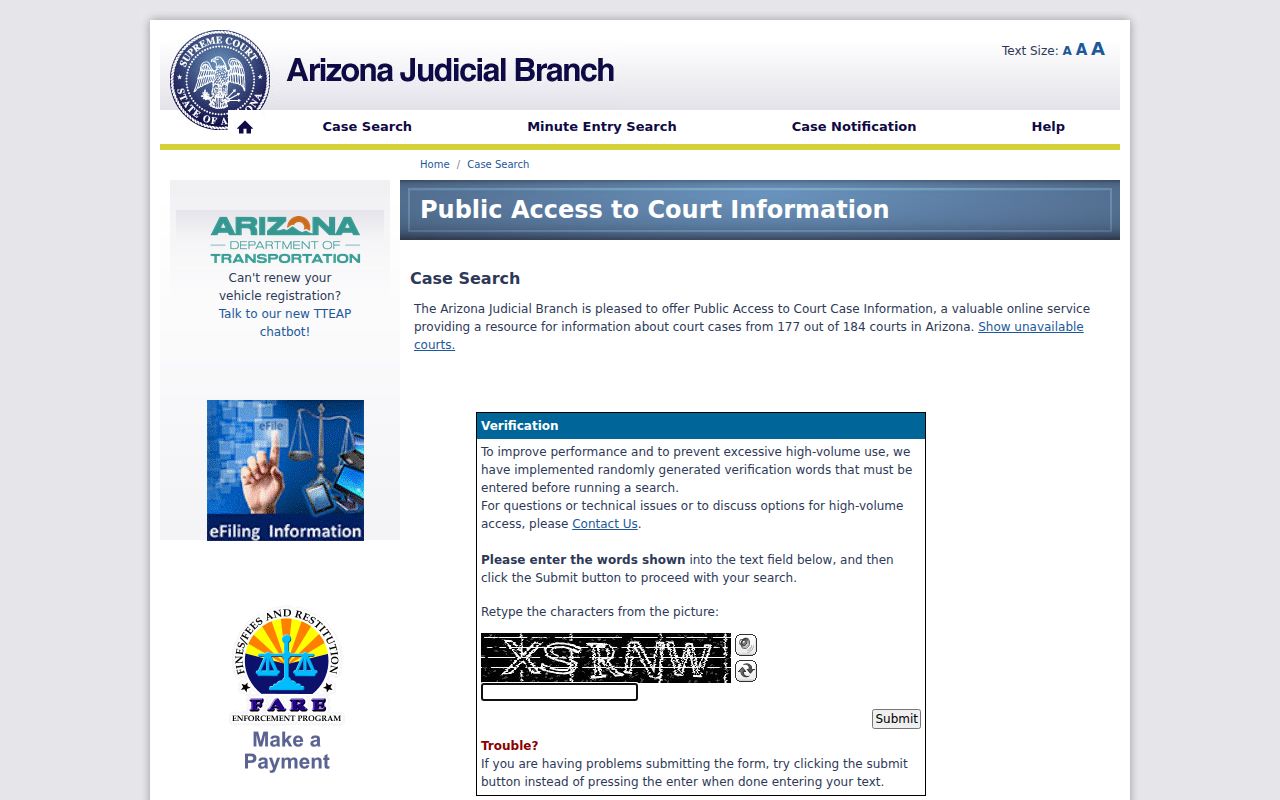
A Prescott match should be tied to the right court, case number, dates, and Clerk file before any conclusion is drawn.
Arizona Voter Lookup Limits
The Arizona Voter Information Portal lets a voter confirm their own registration, districts, notices, ballot-by-mail status, and participation history. It is not a public name or street browser for Prescott resident rolls. Participation history shows elections in which a voter participated, never ballot choices.
A.R.S. §16-168 limits voter-file inspection and copies to listed political, campaign, election, redistricting, or otherwise authorized purposes. Sensitive fields such as Social Security data, driver identification, signature, email, birthplace, and parts of birth date stay confidential. Protected-voter and Address Confidentiality Program addresses are suppressed. Unauthorized transfer or internet redistribution can be a felony.
The official voter self-service screen demonstrates the portal's personal-account role.
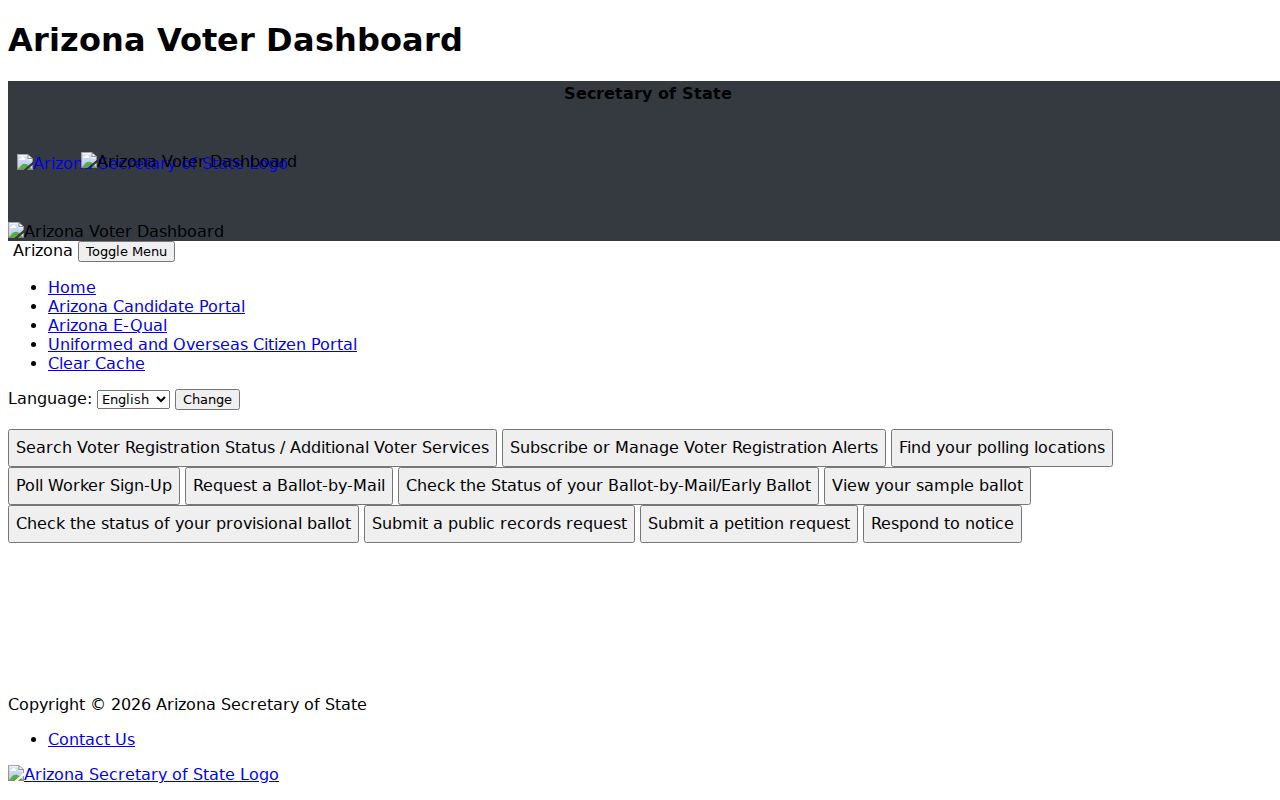
For a lawful county voter-file request, the Yavapai Recorder requires the stated purpose and handles the county process at 1015 Fair Street.
Prescott Vital Records Directory
Arizona birth and death records shift from restricted certificates to genealogy sources after statutory periods. Birth records become archival and public after 75 years; death records after 50 years. Current certified copies remain limited to qualified requesters under A.R.S. §§36-324 and 36-351. Marriage licenses and divorce decrees come from the filing county's Clerk of Superior Court, not the state vital-record office.
The Arizona Department of Health Services handles the state framework for eligible certified copies. A birth or death certificate costs $20, requires the proper application and proof, and should not be confused with a free noncertified historic image.
The official Arizona vital-record office is shown below.
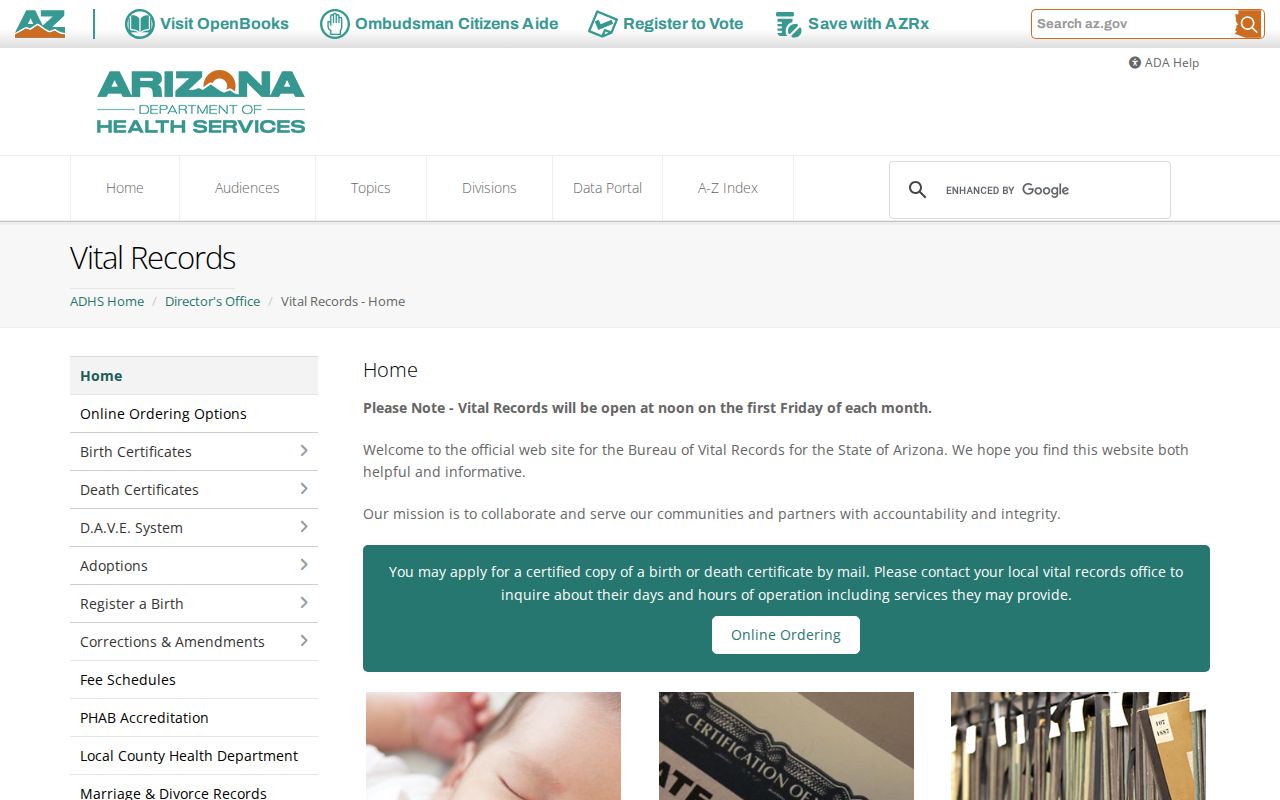
The Prescott trail often crosses agencies: ADHS for a closed-period certificate, the Clerk for marriage or divorce, and the Arizona State Archives for older open material.
Prescott Business Resident Clues
A business record can help distinguish people who share a name. Arizona corporations and LLCs are filed with the Arizona Corporation Commission, while the Secretary of State separately handles trade names, UCC filings, and notaries. Public entity results generally show the entity name and number, status, formation date, statutory agent and address, known place of business, principals, and filed documents.
The ACC eCorp public search shown below is free; an account is needed to file or manage an entity, not to search.

A business or agent address proves a filing connection, not a home address. Pair the stable entity number with dates, names, and another official source before treating the filing as a Prescott identity match.
Prescott Heirs and Reunions
Different human questions call for different official paths. An heir search starts with the Yavapai Superior Court probate file because probate is omitted from statewide Public Access. Former classmates can be traced through Arizona Memory yearbooks and Prescott library or Sharlot Hall holdings. Adoption files remain confidential under A.R.S. §8-121, so birth-family contact must use Arizona's authorized confidential-intermediary and court process rather than an open directory.
Unclaimed property can supply a further name clue tied to a last known Arizona context. The Arizona Department of Revenue search pictured below accepts an optional first name plus a last or business name. Searching and claiming are free.
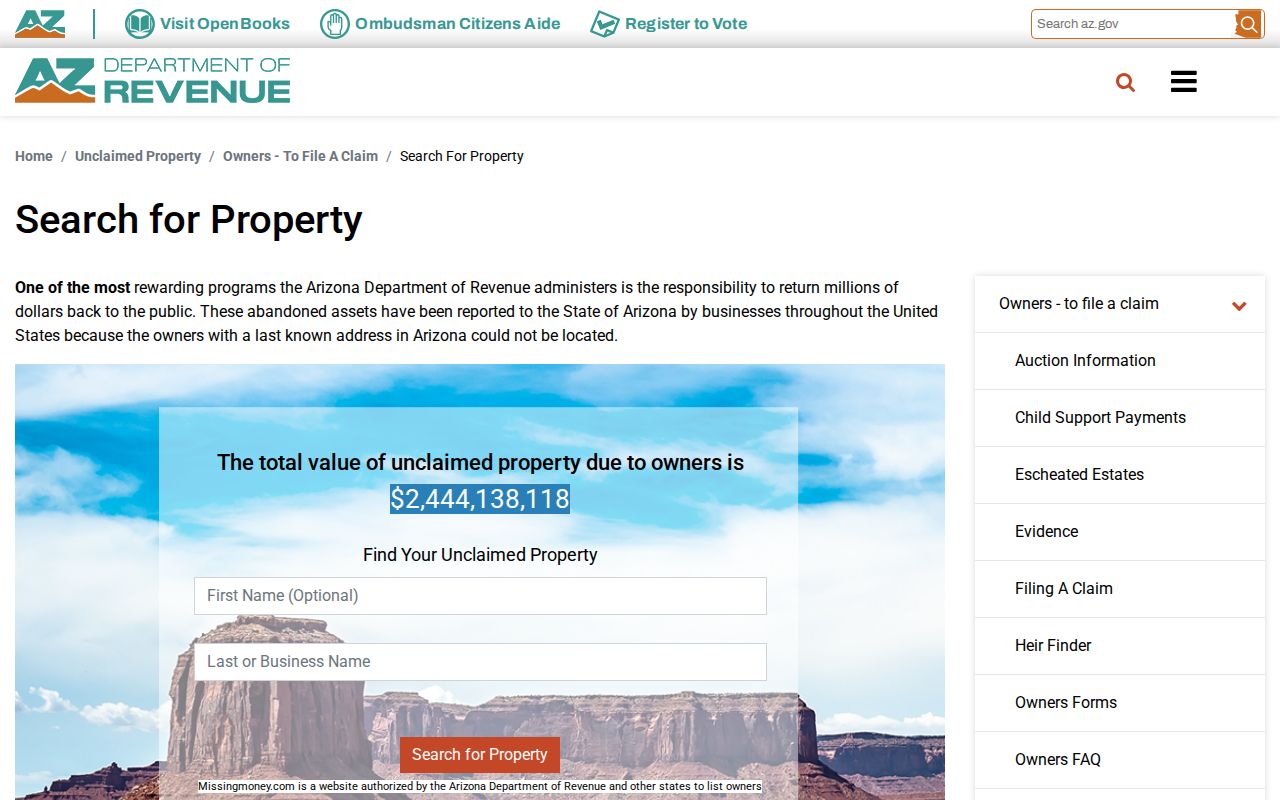
An unclaimed-property hit is a lead, not proof of current Prescott residence. The claimant must provide evidence to recover property.
Prescott Records Request Workflow
When a city record is absent from the Clerk's agenda, minute, ordinance, and resolution search, use Prescott JustFOIA. New requests moved there on February 17, 2026; open legacy requests remain in the prior system. A precise request should name the record type, subject, date range, relevant people, and preferred format. Arizona law does not force an agency to create a record that does not exist or compile data into a new product.
The current Prescott request portal pictured below starts with “New Request.” Choose the fitting form, describe the record, and keep the emailed Request Number and Security Key. Both are required in “Track Status” to retrieve a release.
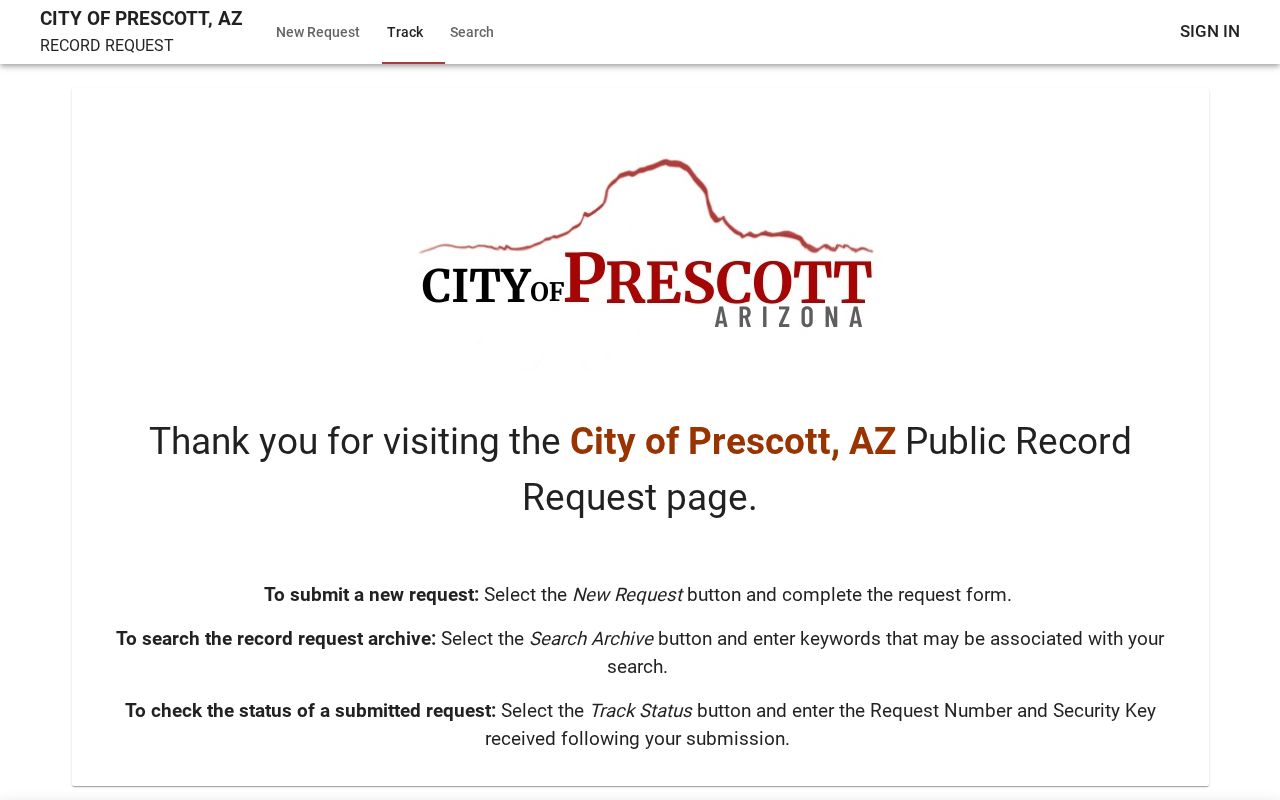
City requests do not replace county routes. Ownership goes to the Assessor, deeds to the Recorder, and court or probate files to the Clerk.
Historical Prescott Residents Directory
Prescott's printed directory trail begins with the Journal-Miner city and business directory of 1903-04. Other verified runs include the 1912-13 Polk gazetteer, Yavapai directories from 1913, 1916, 1919, and 1922, selected 1920s volumes, a 1939 directory, Sharlot Hall runs from 1951 through 1958, a 1961 directory, and the 1963 Luskey criss-cross. The last is especially useful because it reverses an address to a listed subscriber or occupant.
Arizona Memory, the State Research Library, FamilySearch, Prescott Public Library, and Sharlot Hall divide the digital and shelf access. The 1953-54 volume contains full Prescott entries but only names for many outer Yavapai communities, so a name in that county book does not prove city residence. The Prescott Directory Book collections provide the full shelf and reading method.
Directory dates are snapshots. Record names and initials exactly, compare adjacent editions, then pair them with public census schedules through 1950, parcels, deeds, newspapers, and probate. Sharlot Hall adds maps from 1864, nearly ninety years of directories, oral histories, and more than 90,000 photographs for family and house research.
Prescott Records Across Geography
Postal Prescott, incorporated Prescott, and historic Prescott are not the same shape. ZIP codes are delivery geography. A Prescott mailing line can sit outside the city, while the unique 86313 code belongs to the Bob Stump VA Medical Center rather than a normal neighborhood. County GIS can compare a ZIP result with the incorporated-area layer, but USPS remains the final postal authority.
The Whipple Heights and Joslin area shows why geography changes the record trail. The original cemetery dates to 1864, Whipple Heights Addition to 1908, Joslin subdivisions to the 1920s, and annexation to September 1925. A parcel can therefore appear in county and subdivision records before it enters city records. Keep situs, tax mailing, and legal description as three distinct location keys.
State Archives provides a precise offline fallback: Prescott city records are cataloged as RG 127 and Yavapai County records as RG 113. Those record groups can reach beyond current web portals.
Protecting Prescott Resident Addresses
Arizona privacy is record-specific. The Address Confidentiality Program supplies a substitute address for qualifying people who fear for their safety. Application occurs in person through a registered Application Assistant, and certification lasts five years. Separate statutes allow eligible people to seek court orders protecting Recorder, Assessor, Treasurer, and voter addresses. Yavapai applicants begin with the Clerk of Superior Court.
Corrections also go to the actual custodian: the Assessor for parcel facts, Recorder for indexing, Clerk for court entries, licensing board for a professional profile, and County Recorder for registration. Arizona has no verified universal consumer-data deletion right as of August 2026, so a private service's opt-out cannot alter an official deed, assessment, court, or voter record.
Use Prescott records only for lawful personal, family, civic, or safety research. Never use directory facts to stalk, harass, threaten, or harm anyone.
Checking Prescott Record Costs
Confirm a fee on the custodian's official page before paying. Yavapai Recorder copies cost $1 per page with $3 certification, and its free Recorded Document Alert emails basic recording information and a link for a subscribed name or business. The alert still requires a same-name check. Arizona unclaimed-property searches and claims are free, and the Department of Revenue says it does not text owners.
Scams often inflate deed-copy prices, demand a fee for unclaimed funds, or use public obituary and directory details to make a family emergency sound real. Open the agency's .gov page independently and call the published number rather than a number in the message. Report deceptive solicitations to the Arizona Attorney General or FTC ReportFraud.
Prescott's 1900 fire is another reason to check claims against evidence. It destroyed the young public library collection and reshaped downtown construction, but no authoritative source establishes that it destroyed county deed or court books. Sanborn maps and building records help trace the rebuilt blocks without inventing a government-record gap.